
Galvanized Pipe Systems in Commercial Buildings
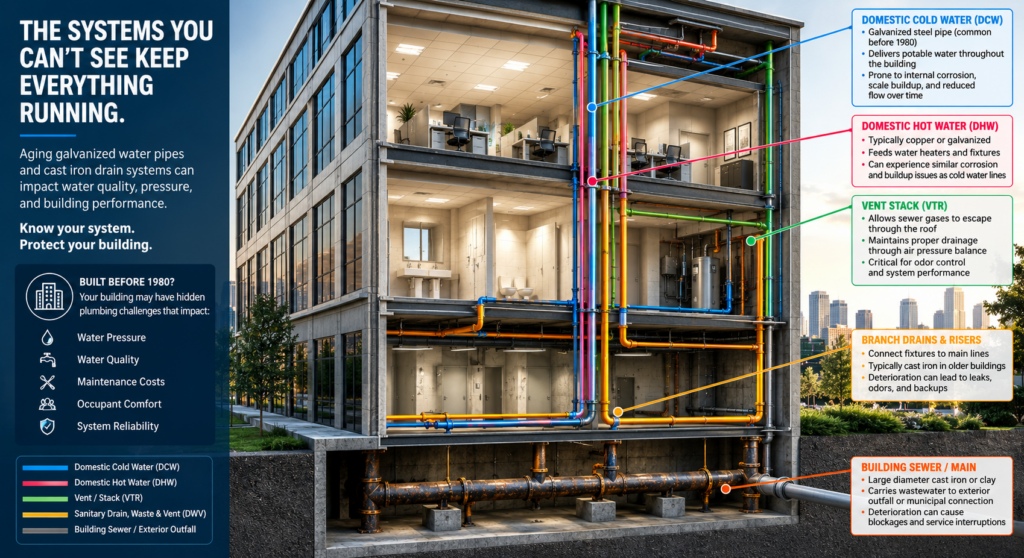
The Complete Facilities Management Guide to Inspection, Lifespan, Restoration, and Replacement
Estimated Reading Time: 15–20 minutes
Last Updated: November 2026 (update this as you revise the guide)
Topics Covered:
- Lifespan
- Warning Signs
- Water Quality
- Restoration vs. Replacement
- ePIPE® Technology
- FAQs
PART 1: THE PROBLEM
How Long Do Galvanized Pipes Last in Commercial Buildings?
You know your building by its work orders. The mechanical room that always needs attention. The restroom everyone complains about. The pressure problem that never seems to stay fixed. The valve that has been replaced twice. The mystery odor that disappears before the contractor arrives. The tenant who says the water pressure is not what it used to be.
None of those work orders exist in isolation. They are telling the story of your plumbing infrastructure.
For Facilities Management Professionals responsible for commercial buildings constructed before 1980, aging plumbing rarely announces itself with one dramatic failure. It usually shows up slowly, then repeatedly. Another repair. Another shutdown request. Another after-hours call. Another budget question from ownership. Over time, the building begins to consume more maintenance attention than it should, and the plumbing system becomes a source of operational uncertainty.
Core insight: The Facilities Management Professional is the hero of this article. TDT Plumbing is the guide that helps them move from reactive repairs to a long-term infrastructure strategy. |
Houston’s Older Commercial Buildings Carry Decades of Infrastructure Decisions
Houston’s commercial skyline reflects decades of rapid growth. Downtown Houston, Greenway Plaza, Upper Kirby, Midtown, Montrose, The Heights, and portions of The Galleria area all include commercial properties that were developed, expanded, renovated, or repositioned during the twentieth century. Familiar skyline anchors such as Pennzoil Place, One Shell Plaza, Allen Center, and Heritage Plaza are reminders of the era when Houston’s office and commercial markets grew quickly, especially during the 1960s and 1970s. Pennzoil Place, for example, was completed in 1975 and remains one of Houston’s most recognizable towers. One Shell Plaza was completed in 1971 and became an important part of the city’s downtown profile.
This does not mean every older building still has original piping in service. Many properties have completed renovations, repairs, selective replacements, tenant improvements, and mechanical upgrades. But Facilities Management Professionals know the reality: plumbing is often the system that remains hidden the longest. Lobbies can be refreshed. Elevators can be modernized. Lighting can be upgraded. HVAC equipment can be replaced. Plumbing, however, often stays behind walls, above ceilings, inside chases, and below slabs until a failure forces the issue.
That is why buildings constructed before 1980 deserve a closer look. They may contain remaining galvanized domestic water piping, aging cast iron sanitary lines, or older vent stacks that have reached the stage where isolated repairs no longer tell the full story.
How Long Do Galvanized Pipes Last in Commercial Buildings?
Galvanized steel pipe was widely used for domestic water systems because it was strong, available, and protected by a zinc coating intended to resist corrosion. It was not a bad product. It did what it was expected to do for decades. The problem is time. Water never stops moving. Minerals never stop accumulating. Corrosion never takes a day off.
Most galvanized piping systems are commonly discussed within a broad expected service life range of approximately 40 to 70 years, depending on water chemistry, usage patterns, installation quality, pipe diameter, and maintenance history. The American Society of Civil Engineers has also noted that many water infrastructure systems installed after World War II are reaching the end of their design life, with postwar pipelines commonly associated with 75 to 100 year lifespans in broader infrastructure discussions. For commercial buildings constructed before 1980, that timeline matters. Many systems are no longer young assets. They are legacy infrastructure.
A galvanized pipe does not need to burst to create a problem. It can quietly lose capacity from the inside as the zinc coating wears away, the steel begins to oxidize, and rust and mineral deposits reduce the interior diameter of the pipe. Building occupants experience the symptom. Facilities teams inherit the work order.
- Declining water pressure in certain areas or upper floors
- Rust-colored water after periods of inactivity
- Frequent valve and fitting replacements
- Pinhole leaks or recurring repairs in different parts of the building
- Inconsistent flow between fixtures
- Increasing plumbing-related work orders
- Tenant complaints that appear unrelated until the pattern becomes clear
The Uncomfortable Truth: The Building May Be Asking for a Plan
Facilities Management Professionals are not looking for a basic explanation of galvanized pipe. They already understand the system. What they need is a practical way to decide when a group of repairs has become an infrastructure issue. That is the point where the conversation changes from maintenance to planning.
It is one thing to repair a leak. It is another thing to defend a maintenance budget that keeps rising because the same aging system is failing in different ways throughout the building. It is one thing to replace a valve. It is another thing to explain why water pressure complaints keep returning. It is one thing to respond to a tenant issue. It is another thing to know the building is quietly moving toward a larger capital decision.
This is where many commercial properties get caught. Traditional maintenance keeps the building running, but it does not always address the underlying infrastructure condition. The result is death by a thousand work orders. Each repair may be reasonable. Collectively, they may be evidence that the building needs a different strategy.

Why This Matters for Occupied Commercial Buildings
In an occupied commercial building, plumbing is not just a mechanical system. It is part of the occupant experience, the maintenance budget, the capital plan, and the operational risk profile. A water interruption affects tenants. A leak can damage finishes, equipment, records, ceilings, flooring, and adjacent spaces. Repeated work orders pull engineering teams away from higher-value preventive work. Recurring plumbing issues can also shape how occupants perceive the building, even when the Facilities team is doing everything possible to keep the property running.
For TDT Plumbing, this is where the opportunity to serve as a guide begins. The goal is not to tell Facilities Management Professionals what they already know. The goal is to help them evaluate the condition of aging infrastructure, understand the options, and make decisions that reduce disruption while extending the useful life of critical building systems.
PART 2: THE SOLUTION
It Is Not Just the Water Pipes
How TDT Helps Facilities Management Professionals Restore Aging Plumbing Infrastructure Without Treating Every Problem as a Repipe
Publishing note: This section is written as part of one long-form cornerstone article for the Facilities Management Professionals Resource Hub. When the three documents are combined, the final article is designed to function as a flagship resource for TDT Plumbing. |
The Smell Everyone Tries to Ignore
Every Facilities Management Professional knows the email. The restroom smells like sewer. Maintenance checks the floor drain. The trap is refilled. The restroom is cleaned again. Someone asks whether the HVAC system is pulling odors from another area. The smell disappears. Then it returns three weeks later.
These complaints are frustrating because they rarely behave on command. The odor may be obvious to occupants at 8:15 a.m. and completely gone by the time the contractor arrives. It may affect one restroom, one corridor, one tenant space, or one floor. It may be blamed on housekeeping, cleaning chemicals, floor drains, or air movement. Sometimes those are part of the issue. But in older commercial buildings, the sanitary drain, waste, and vent system has to be part of the conversation.
Aging plumbing infrastructure is not limited to the domestic water system. Drain, waste, and vent systems age as well. Cast iron sanitary piping, vent stacks, and drain lines are exposed to decades of wastewater, moisture, cleaning products, changing usage patterns, and sewer gases. Hydrogen sulfide in wastewater systems is a known contributor to corrosion and odor concerns, and EPA resources have addressed the consequences, detection, and correction of hydrogen sulfide corrosion in wastewater systems.
Facilities reality: The odor complaint is often not the real problem. It is the symptom that finally makes an invisible system visible. |
Domestic Water and DWV Systems Age Together
Facilities teams often separate plumbing issues into categories: water pressure, leak repair, drain backup, odor complaint, fixture issue, valve replacement. That makes sense from a work order standpoint. But from an infrastructure standpoint, those issues may be connected by age, use, and deterioration.
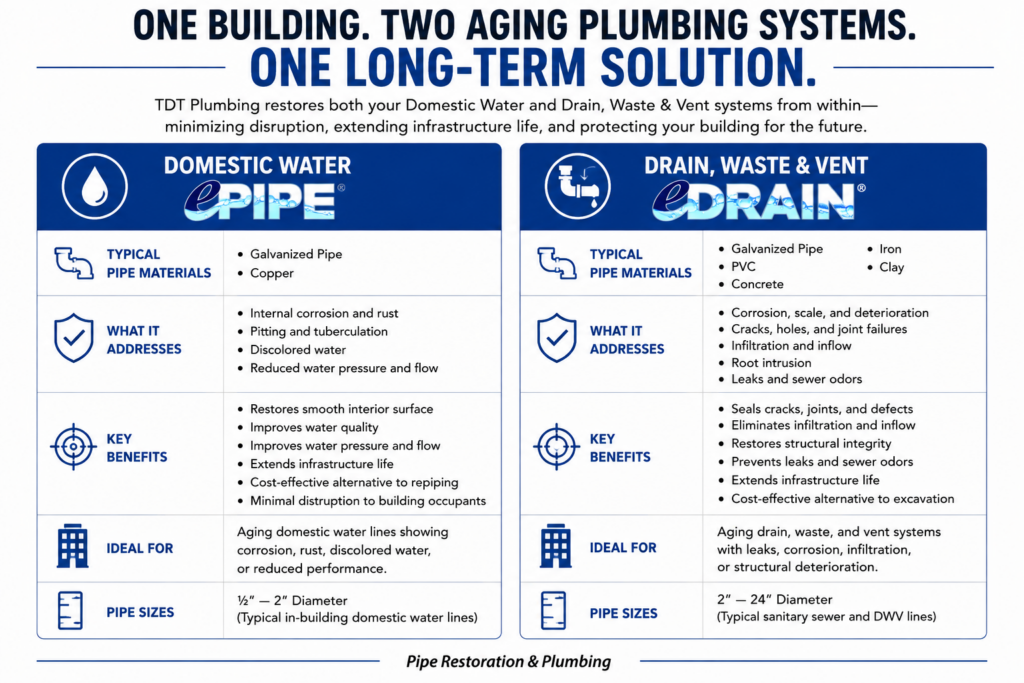
A commercial building has two major plumbing systems that Facilities Management Professionals must keep operating: the domestic water system and the drain, waste, and vent system. The domestic water system delivers potable water under pressure. The DWV system removes wastewater and vents sewer gases safely out of the building. When both systems are aging, the building can experience a combination of pressure complaints, water quality concerns, leaks, drain problems, sewer odors, vent issues, and repeated maintenance demands.
Why Traditional Repiping Is Not Always Practical
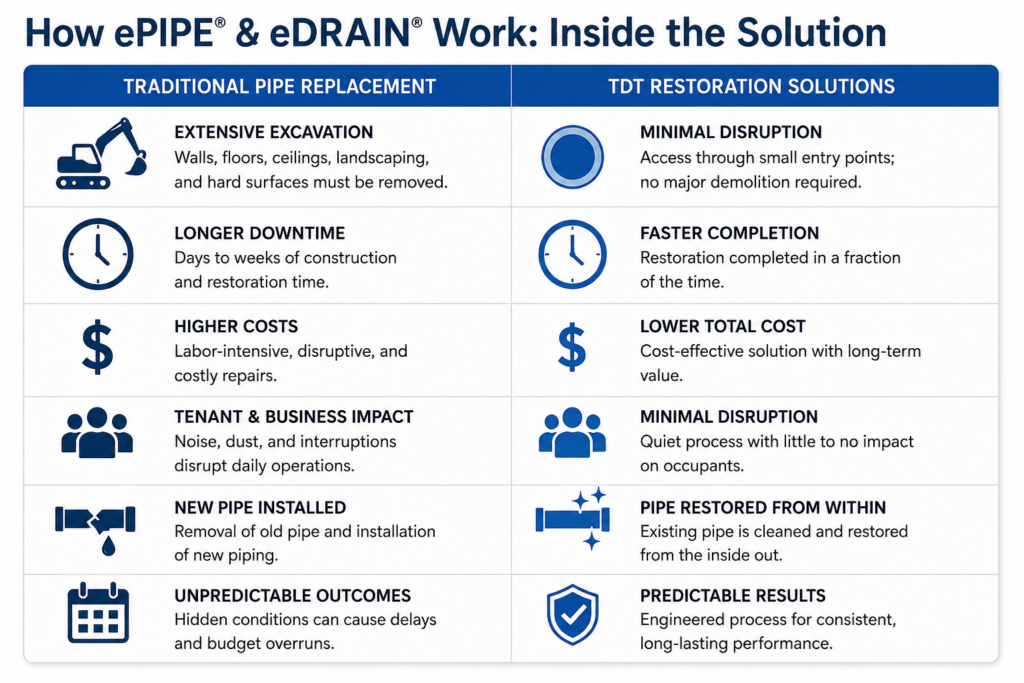
Every Facilities Management Professional understands what the phrase complete repipe can mean inside an occupied commercial building: demolition, ceiling access, wall openings, dust, noise, tenant coordination, temporary shutdowns, after-hours scheduling, multiple trades, reconstruction, and the change orders that tend to appear once walls are opened.
In some cases, replacement is necessary. TDT can perform repiping when that is the right recommendation. But many occupied commercial buildings need an option that addresses aging infrastructure without turning the building into a construction zone. For offices, healthcare facilities, hotels, schools, churches, industrial facilities, and multifamily properties, operational continuity matters. A solution that reduces disruption can be a major win for the Facilities team, ownership, occupants, and the building itself.
This is where TDT’s role as the guide becomes important. The recommendation should not begin with a product. It should begin with an assessment. What is in the building? What is failing? Where are the risks? Which systems are candidates for restoration? Which areas may still require selective replacement? What solution protects operations while extending useful life?
ePIPE®: Restoring Domestic Water Systems from Within
ePIPE® is designed for qualifying pressurized domestic water systems. Instead of removing every pipe behind walls and above ceilings, the existing piping is prepared and lined from within using an epoxy barrier that helps address internal corrosion and protect the pipe interior. For Facilities Management Professionals, the value is not simply the technology. The value is the ability to solve a serious infrastructure problem with less disruption than traditional replacement.
That matters because disruption carries a cost. It affects tenants, building operations, maintenance schedules, and internal confidence in the Facilities team. A restoration approach can allow the building to move from reactive repair mode into planned infrastructure stewardship, without assuming that demolition is the default path.
eDRAIN®: Restoring Drain, Waste, and Vent Systems
eDRAIN® extends the same strategic thinking to sanitary drain, waste, and vent systems. Older cast iron drain lines and vent stacks can deteriorate from the inside, creating rough pipe surfaces, corrosion, recurring drain issues, leaks, and conditions that may contribute to odor complaints. eDRAIN® is designed to restore qualifying DWV piping from within, helping extend the life of sanitary infrastructure without replacing every line through demolition.
This is significant because many commercial plumbing conversations focus only on domestic water. TDT can speak to the entire building. Domestic water and sanitary drainage are different systems, but Facilities Management Professionals are responsible for both. When both are aging, a holistic solution can create a more practical long-term plan.
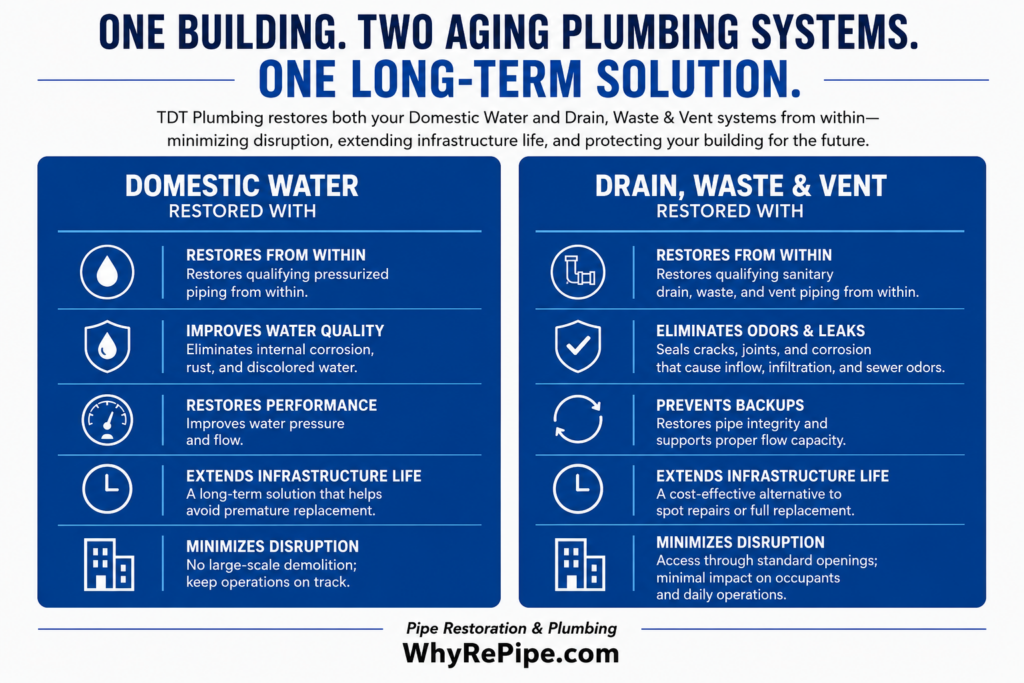
One Building. Two Aging Systems. One Long-Term Strategy.
The most important shift is not from repiping to restoration. The most important shift is from isolated repairs to infrastructure strategy. When TDT evaluates both domestic water and DWV systems, the Facilities Management Professional gains a clearer view of the building as a whole. The conversation becomes more useful because it is no longer about chasing the next leak or odor complaint. It is about extending the life of the building’s plumbing infrastructure and reducing operational uncertainty.
From Emergency Repair to Infrastructure Stewardship
How Facilities Management Professionals Can Use Aging Plumbing Data to Plan, Prioritize, and Protect Building Operations
Publishing note: This section is written as part of one long-form cornerstone article for the Facilities Management Professionals Resource Hub. When the three documents are combined, the final article is designed to function as a flagship resource for TDT Plumbing. |
You Were Not Hired to Chase Plumbing Emergencies
Facilities Management Professionals are measured by how well they keep buildings operating. The best work is often invisible. The leak that never happens. The shutdown that is avoided. The tenant complaint that never reaches ownership. The capital need that is identified early enough to plan for it responsibly.
That is why aging plumbing infrastructure should not be treated only as a repair issue. It is an asset management issue. It affects risk, budgets, operations, occupant experience, and long-term building performance. When a commercial building was constructed before 1980, and when work orders are beginning to tell the same story from different parts of the property, it may be time to move from repair response to infrastructure planning.
TDT Plumbing helps Facilities Management Professionals make that shift. Not by assuming every building needs a full repipe, and not by treating every issue as a product sale. The better first step is understanding what the building has, what condition those systems are in, and whether restoration with ePIPE® and eDRAIN® can extend useful life while minimizing disruption.
What a Commercial Plumbing Infrastructure Assessment Should Clarify
A useful assessment should help the Facilities team answer practical questions that support maintenance and capital planning. It should identify known risks, document system conditions, and help determine whether the building is a candidate for restoration, selective replacement, or a phased plan.
- Are galvanized domestic water lines still present in the building?
- Are cast iron sanitary lines or vent stacks showing signs of age or deterioration?
- Are work orders increasing in frequency, cost, or geographic spread within the building?
- Are water pressure complaints isolated or system-wide?
- Are sewer odor complaints tied to drain, waste, and vent system conditions?
- Can ePIPE® restore qualifying domestic water piping?
- Can eDRAIN® restore qualifying sanitary drain, waste, and vent piping?
- What work should be prioritized immediately, and what can be planned over time?
For Facilities Management Professionals, this information is valuable because it turns symptoms into a plan. It helps support budget conversations, risk discussions, and long-term maintenance decisions with more confidence.
Downloadable Resource CTA
Free resource: Download the Commercial Plumbing Infrastructure Planning Guide: A Facilities Management Professional’s Guide for Commercial Buildings Constructed Before 1980. This guide is designed to help Facilities teams identify warning signs, understand the lifecycle of aging plumbing systems, compare restoration and replacement considerations, and prepare for more productive infrastructure planning discussions. |
Frequently Asked Questions
How long do galvanized pipes last in commercial buildings?
Galvanized pipes are commonly associated with an expected service life of roughly 40 to 70 years, depending on water chemistry, usage, installation, and maintenance history. In commercial buildings constructed before 1980, remaining galvanized piping should be evaluated as aging infrastructure rather than assumed to be reliable indefinitely.
Does every older commercial building need a full repipe?
No. Some buildings may require selective replacement or full repiping, but others may be candidates for restoration. TDT evaluates the condition of the systems first, then helps determine whether ePIPE®, eDRAIN®, selective replacement, or a phased plan is the best fit.
What causes sewer odors in older commercial buildings?
Sewer odors can come from several sources, including dry traps, venting problems, deteriorated drain piping, failed seals, or aging drain, waste, and vent systems. In older buildings, recurring odor complaints should prompt a closer look at the sanitary system rather than repeated surface-level fixes alone.
What is the difference between ePIPE® and eDRAIN®?
ePIPE® is used for qualifying pressurized domestic water systems. eDRAIN® is used for qualifying drain, waste, and vent piping. Together, they allow TDT to evaluate both sides of the building’s plumbing infrastructure rather than treating water and sanitary systems as unrelated issues.
Why is restoration attractive for occupied commercial buildings?
Restoration can reduce the need for widespread demolition, extended shutdowns, and reconstruction. For occupied buildings, minimizing disruption is often one of the most important factors in choosing a plumbing infrastructure strategy.
When should a Facilities Management Professional schedule an assessment?
An assessment is appropriate when a building constructed before 1980 has recurring leaks, pressure complaints, rust-colored water, sewer odors, repeated drain issues, or increasing plumbing-related work orders. The earlier the condition is understood, the easier it is to plan strategically.
The Decision Point
Every older commercial building eventually reaches a decision point. Continue repairing what fails next, or step back and evaluate the condition of the system as a whole. Neither choice is theoretical. One creates a pattern of reactive maintenance. The other creates a path toward infrastructure stewardship.
For Facilities Management Professionals, the win is not simply extending pipe life. The win is reducing uncertainty. It is creating a plan before a crisis. It is helping ownership understand why the building needs attention before damage, disruption, or emergency costs force the issue. It is protecting occupants and operations without assuming the most disruptive option is the only option.
TDT as the Guide
TDT Plumbing’s role is to help Facilities Management Professionals understand their options and make informed decisions. That means evaluating the full plumbing infrastructure, explaining where restoration may be appropriate, identifying where replacement may still be necessary, and helping develop a practical strategy that supports the way the building actually operates.
The Facilities Management Professional remains the hero of the story. They are the ones responsible for keeping the building running, managing expectations, protecting budgets, and making smart decisions under pressure. TDT serves as the guide with the expertise, technology, and process to help them move forward with confidence.
Conclusion
Aging galvanized piping, cast iron sanitary lines, and older vent systems are not just plumbing concerns. They are building infrastructure concerns. In Houston’s older commercial properties, these systems may have served reliably for decades, but time changes the risk profile. What once worked quietly behind the walls may now be generating work orders, occupant complaints, budget pressure, and operational uncertainty.
The answer is not always to tear everything out. For many qualifying buildings, TDT Plumbing can help restore domestic water systems with ePIPE® and drain, waste, and vent systems with eDRAIN®, creating a more holistic approach that may extend plumbing infrastructure life by 50 years or more while minimizing disruption to occupied buildings.
If your commercial building was constructed before 1980, or if plumbing work orders are beginning to feel like a pattern rather than isolated events, now is the time to evaluate the system before the next failure forces the decision.
Schedule a commercial plumbing infrastructure assessment with TDT Plumbing to determine whether your building is a candidate for ePIPE® and eDRAIN® restoration.